Thank-you flowers are the easiest bouquet to get right. Nobody is counting the days, there is no fixed date, and almost any gesture is welcome. The only real decisions are who, where and how much.
Who you might thank
Life in a new country runs on small favours, and many of them come from people you did not know a year ago.
- A dinner host. You can bring flowers on the night, but sending them the following day is often more practical: the host is not hunting for a vase while the risotto burns, and the thank-you arrives when the evening is still fresh in their mind.
- A neighbour. The one who received your parcels, watered your plants, or lent you a drill. In an apartment building, where you may share a stairwell with the same people for years, a small bouquet goes a long way.
- A colleague or a team. For help on a project, a warm welcome in your first weeks, or covering for you during a move.
- A teacher or childcare worker. At the end of the school year, after a difficult term, or when your child moves on. A joint bouquet from several families is easy to organise.
- Someone who helped with the move. A relocation agent, a landlord who was unusually helpful, a friend who drove the van.
- A family abroad thanking someone in Switzerland. Parents thanking the family who hosted their exchange student, or relatives thanking a friend who looked after someone in hospital.
Our page on flower-giving etiquette in Switzerland has more on what is customary and what to avoid.
When to send
There is no deadline for gratitude, but sooner is warmer. The day after a dinner or within the same week is ideal.
| Recipient in | Order before | Delivered |
|---|---|---|
| Canton of Geneva | 2 pm, Swiss time | Same day, Monday to Saturday |
| Rest of Switzerland | 4 pm, Swiss time | Next day, Tuesday to Saturday, 7 am to 6 pm |
There is no delivery on Sundays. Outside Geneva, there is no delivery on Mondays either, so if you had dinner with friends in Basel on Saturday, the earliest a bouquet can arrive is Tuesday. That is perfectly fine for a thank-you.
If the dinner is on your calendar in advance, you can book the bouquet for the following day before you even go. Delivery dates can be chosen up to 14 days ahead.
Home or office?
Home suits personal thanks: a host, a neighbour, a friend. The courier needs the name shown on the letterbox and doorbell, and that matters more in Switzerland than in many countries. See why the name on the letterbox matters.
If the recipient is out, the bouquet is usually left at the door or in a safe place, and they receive a WhatsApp message to say flowers have arrived. The stems sit in a water reservoir inside a cardboard box, so a few hours’ wait is not a problem.
The office suits professional thanks, and a bouquet on a desk is visible in a way a private thank-you is not. That is lovely for a team, less so for someone who prefers to keep things discreet. Add the company name, building, floor and department, and make sure reception is staffed on the delivery day. Our office delivery guide explains what to check.
For a teacher, ask the school whether deliveries are accepted, or send to the teacher’s home if you know the address and it would be welcome.
How much to spend
Match the bouquet to the favour, not to how grateful you feel. An oversized bouquet for a small kindness can embarrass the recipient.
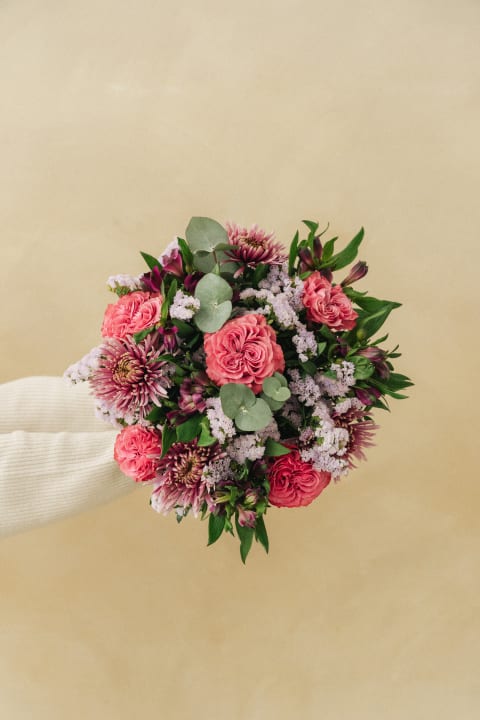
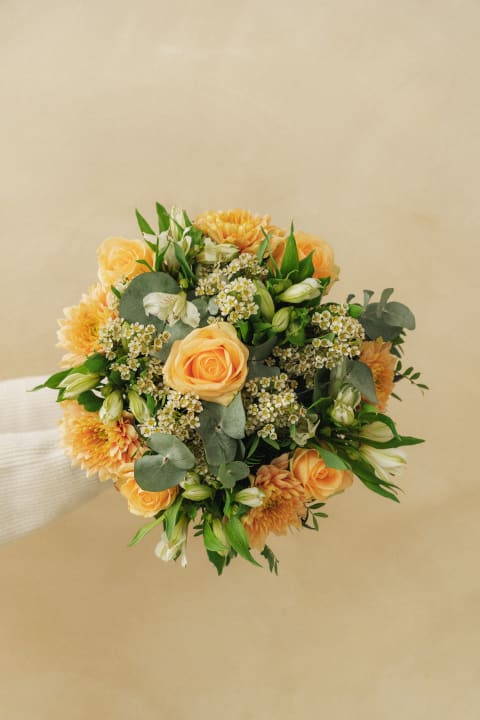
- Small favours (watering plants, a dinner invitation): a timeless bouquet in the smallest size, from CHF 64.90.
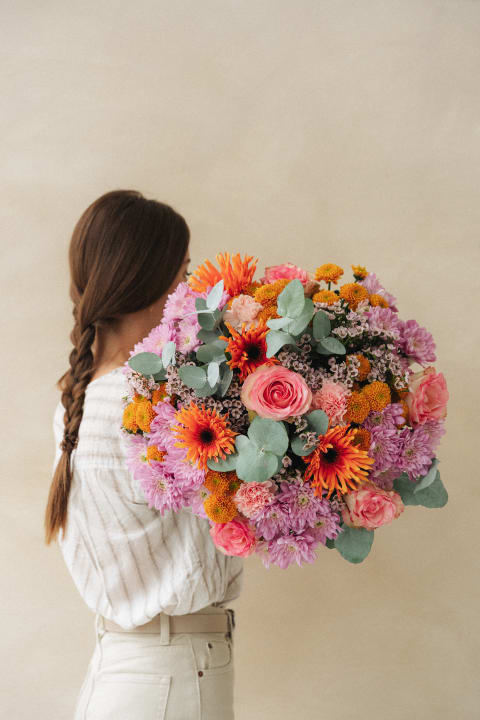
- Bigger favours (weeks of help, a difficult period): a seasonal bouquet, from CHF 74.90, in the middle or large size.
- A whole team or a joint gift: the large seasonal bouquet, from CHF 124.90, gives everyone something to look at.
Rose bouquets usually read as romantic, so for most thank-yous, timeless or seasonal is the better choice. You can compare collections on our bouquets page, or go directly to KANEL’s timeless bouquets.
Thanking a man
Flowers are not only for women. If you are unsure, pick a structured bouquet in deep or neutral colours, and keep the card short and direct. “Thank you for the help with the move, Marco. The beer is on me next time.” does the job perfectly.
The card
A message card is free from CHF 55 and costs CHF 2.90 below that. A thank-you card works best when it names the favour: it shows you noticed what they did, not just that you are polite.
- “Thank you for a wonderful evening, and for the recipe. We will try it this weekend. Emma and Luis”
- “For the plants, the parcels and the patience. Thank you. Flat 3”
- “Thank you for making Leo’s first year at school such a happy one. From the Patel family”
- “Thank you for looking after Mum while we could not be there. We are so grateful. Kate and James, Melbourne”
Signing with a flat number or “your neighbours from the second floor” works well in a building where people know each other by sight but not by name.
Writing in English
An English card is entirely normal in Switzerland, even to a neighbour who mostly speaks French or German. If you would like to make the effort, a single word in the local language is a nice touch: “Merci”, “Danke” or “Grazie”, followed by your English message.
Checklist
- Name the favour on the card.
- Match the size to the favour.
- For home: name on the letterbox, street, number, postcode, town.
- For an office: company, building, floor, and a staffed reception.
- Order on kanel.ch and use code KANEL5 for 5 % off.